
Why Men Won’t Go to Therapy (And Why Walk and Talk Changes That)
Have You Been Finding It Difficult to Ask for Support?
You may feel anxious, low, stressed, overwhelmed or simply unlike yourself. You may also feel that therapy is not really “for you”.
You do not have to manage everything alone.
For some men, the idea of counselling can feel unfamiliar, uncomfortable or even difficult to explain. That hesitation does not mean you are weak, unwilling or doing anything wrong. It may simply mean that the usual image of therapy does not feel like a natural fit.
At Look Forward Therapy, I believe support should meet you where you are. That is why I offer Walk and Talk therapy as one flexible way to talk, reflect and begin moving forward at your own pace.
You do not need to have everything figured out before you start.
Why Therapy Can Feel Difficult for Some Men
There is no single reason why men may hesitate to seek therapy. Everyone’s circumstances are different.
Some men have grown up with the expectation that they should stay strong, remain in control and deal with problems privately. Asking for help can then feel like admitting that something has gone wrong, rather than recognising that support may be useful.
Others may not have had much opportunity to talk openly about their emotions. You may know that something does not feel right, but not have the words to describe it. Or perhaps you have become used to putting difficult feelings aside and carrying on.
Practical concerns can matter too. You may worry about taking time away from work or family. You may be unsure what counselling involves, whether you will get on with a counsellor, or what you are expected to say.
You may also wonder whether your concerns are “serious enough”.
They are worth talking about if they are affecting your life.
The Mental Health Foundation’s guidance on men and mental health recognises that social expectations, stigma and difficulty expressing emotions can all affect whether men seek support. A UK Government call for evidence on men’s health also highlights practical access and attitudes towards services as important considerations.
These are not personal failings. They are understandable barriers.

When Sitting Face-to-Face Feels Too Much
Traditional counselling often takes place in a quiet room, with two people sitting opposite one another and talking about personal experiences.
For many people, this feels safe and supportive. Face-to-face counselling can offer a private space for connection and reflection, and it may be exactly what you prefer. You can read more about this option through my face-to-face counselling service in Chelmsford.
However, for some men, sitting in a room and maintaining eye contact can feel intense. You may feel as though all the attention is on you. There may be a pressure to speak, explain yourself clearly or show emotion in a particular way.
Even if a counsellor does not expect you to perform or provide answers, the setting itself may feel unfamiliar.
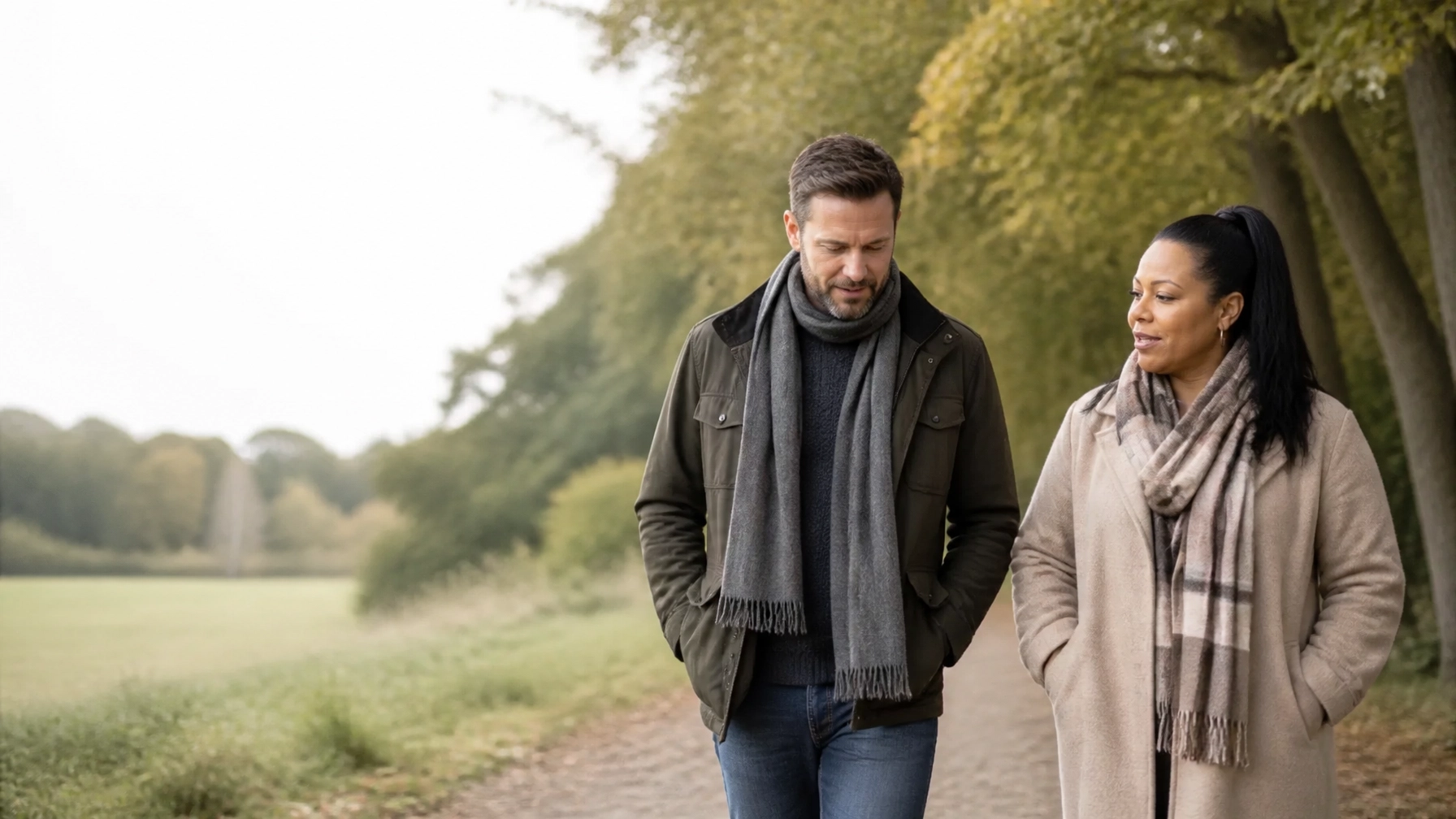
Walk and Talk therapy offers a different starting point. Rather than sitting opposite one another, we walk side-by-side in a suitable outdoor setting. There is no need to hold eye contact throughout the conversation. You can notice the path, the trees, the weather or what is happening around you, allowing the conversation to unfold more naturally.
For some men, that small change can make a meaningful difference.
What Is Walk and Talk Therapy?
Walk and Talk therapy combines counselling with gentle movement, fresh air and conversation in a relaxed natural environment.
It is still counselling. The difference is that the session takes place outdoors and involves walking at a comfortable pace.
A session may include:
- Meeting at an agreed outdoor location
- Walking alongside one another on a suitable route
- Talking about what has been happening for you
- Pausing, slowing down or sitting when needed
- Reflecting on what you would like to understand or change
- Considering practical steps that feel manageable
You do not need to be fit or experienced at walking. This is not a hike, a fitness session or a test of endurance. The pace can be gentle, and we can make adjustments according to your comfort, access needs, the weather and the route.
There may be moments of quiet. You may not know what to say at first. That is okay.
I will work alongside you rather than directing or fixing you. We can talk, reflect and consider what might help, without judgement and without rushing.

Why Walking May Feel More Natural
Walking can create a little more space around a conversation. You are not required to sit still and focus entirely on your counsellor. You can look ahead, take in your surroundings and allow thoughts to come at their own pace.
For some people, gentle movement helps them feel less “on the spot”. It can be easier to begin with what is happening day to day, before gradually exploring more personal or difficult feelings.
The outdoor setting may also feel less clinical. You might be more comfortable saying, “I am going for a walk,” than saying, “I am going to therapy.” That can make taking the first step feel more accessible.
Walk and Talk therapy may appeal to you if you:
- Prefer practical and active forms of support
- Find prolonged eye contact uncomfortable
- Feel more at ease outdoors
- Would like a less formal therapy setting
- Want time to think while you talk
- Feel unsure about sitting in a counselling room
- Are looking for approachable men’s mental health support
This does not mean Walk and Talk therapy is better than other forms of counselling. It is simply another option. The most helpful format is the one that feels safe, suitable and respectful of your circumstances.
The evidence around outdoor counselling is still developing, and experiences will differ from person to person. I will not promise a particular outcome. What I can offer is a confidential, person-centred space where we can explore what you are experiencing together.
Is It Really Confidential Outdoors?
It is reasonable to ask how confidentiality works when counselling takes place outside.
Before we begin, we can discuss the location, route and practical arrangements. I take care to choose settings that support privacy and minimise the likelihood of being overheard. If someone we know happens to pass by, we can agree in advance how you would like to respond, including simply acknowledging one another and continuing.
Outdoor counselling cannot provide exactly the same level of privacy as a closed therapy room. I will explain this clearly so that you can make an informed choice.
You remain in control. If you prefer more privacy on a particular day, we can discuss whether to pause, change the route or consider another counselling format. I also offer telephone counselling for people who prefer confidential support without travel or visual interaction.
Your autonomy matters.
You Can Start Without Knowing Exactly What You Need
You do not need a diagnosis, a prepared explanation or a clear list of goals before contacting me.
You may simply know that you are more withdrawn than usual, that your thoughts will not settle, that you are feeling low, or that you are finding it harder to cope with everyday life. You may be experiencing bereavement, a life change, relationship difficulties, low confidence or a general sense of being stuck.
We can begin with that.
As a counsellor in Essex, I provide support for people in Chelmsford and beyond through in-person, online, telephone and Walk and Talk sessions. My approach is warm, down-to-earth and tailored to each person. I am a Member of the Complementary Medical Association (CMA) and an Accredited Member of the Accrediting Board of Counsellors and Psychotherapists (ABCAP), and I maintain high professional and ethical standards.
I will respect your preferences, your boundaries and your pace. You can ask questions before deciding whether counselling feels right for you.

If You Are Supporting a Man Who Is Hesitant
If someone you care about is reluctant to seek support, it may help to avoid pressure or criticism. Repeatedly telling him that he “needs therapy” can sometimes make him withdraw further, even when the intention is caring.
You might let him know that he does not have to commit to anything immediately. He could ask questions, explore different formats or consider whether a walk-and-talk conversation feels more comfortable than sitting in a room.
You can offer encouragement without taking control.
The decision remains his. Feeling respected can make it easier to consider support when he is ready.
A Gentle Place to Begin
Starting counselling can feel difficult, especially if you are used to handling things on your own. It can also be a positive and empowering decision: not because you have failed to cope, but because you are allowing yourself support.
Walk and Talk therapy may offer a more natural way to begin. There is no pressure to talk before you are ready, and no expectation that you will know exactly what to say.
If you would like to find out more about Walk and Talk therapy, counselling in Chelmsford or men’s mental health support in Essex, you are welcome to contact me with any questions.
A conversation is available when you are ready.
You deserve to feel safe, supported and heard.


Leave a Reply